Snoring has always been part of my life. I assumed I inherited it from my Dad, who snored like a chainsaw. He had polyps removed to try and fix it, but the operation only reduced the snoring.
It almost became part of my character. I felt embarrassed when friends pointed out my snoring, but I stayed completely oblivious to what it really meant. Clearly it was annoying for my wife before she got to sleep, but she slept so deeply she didn’t notice it at first. Later in life she would give my kids advice as to “how to cope with Dad’s snoring” on the occasion when we would all share a hotel room.
I knew that excessive drinking or certain drinks like red wine would make it worst because I would wake myself up with the noise.
The Long Haul Snore
I used to travel to India regularly with work and my good friends over there suggested I got the early morning the return flight from Chennai to Heathrow. They took me out for dinner, beers and whiskies and then they dropped me off at the airport at 0100 so I would sleep on the plane. It was a 10 or 11 hour flight. I remember looking out of the window as the plane took off and then a steward asking if I wanted breakfast.
“Wow, where are we?” I asked.
“Just flying over Berlin.” Said the Steward. “Just a couple of hours until we land.”
“Grief, and I’ve slept all the way?”
“Yes.” said the Steward.
“But no one else has!” scowled the lady sat next to me.
I apologised profusely and didn’t take that approach to the long hauls again – well not intentionally.
Snoring in the Dordogne
Whilst camping in the Dordogne as a family group we arranged the tents in a kind of close arc that gave privacy from the rest of the campsite. Each morning my snoring was the hot topic and one morning I noticed that some of the tents near to us had moved to another part of the field. Uncle P declared it was down to my horrendous snoring and that he didn’t get a wink of sleep either.
Lawn Mower Man
I had a friend stay at ours and when I asked her how she slept she said fine until some idiot started mowing the lawn at three in the morning. And then came the wake-up…
The Wake-up
At 40, my corporate healthcare sent me for a routine check-up. My first private health experience, the medical centre was impressive, very professional staff. Picture it, a clinical white set of rooms, bright lights, the faint smell of disinfectant. They strap you to a bike, put wires on your chest, and a tube in your mouth. You expect a gentle warm‑up. Instead, the technician stops the test almost immediately, looks worried, and tells you they should send you to A&E.
That’s not a normal birthday present.
My blood pressure wasn’t just high. It was dangerous. My resting heart rate of 98 was another red flag. I needed to do something about it. The journey home had me reflecting, how serious is this really? Both Grandads died of a heart attack. So I guess this is how I will go?
Thankfully in those days you could quite easily get a face to face with a regular GP. I had known Dr S for 10 years, so I fully trusted his guidance and advice. He shared the fact that my blood pressure was 198/111, my resting heart rate was 98 and my Cholesterol ratio 6.2. He wanted to address lifestyle and diet in addition to the medication. I made some appointments with the nurse. He prescribed 5mg of Ramipril.
Dr P
A few weeks later, at my kids school sports day, I relayed the stats to a GP friend of mine (Doctor P). I expected the usual lecture get fit, eat better, drink less. Instead, he told me I was a long way down what they called in the trade a “Death Curve.” A chart doctors used to estimate cardiovascular risk over the next ten years. I have mocked one up using AI to help illustrate what he described.
With my blood pressure at 198 and cholesterol at 6.2, P explained it bluntly:
“It’s not if something will happen in the next ten years – it’s when.”
He went on to explain. Anything >180 for the higher, systolic reading or 120 for the diastolic is a serious. And when you add the cholesterol ratio of 6.2 you move up the death curve (cardiovascular curve)
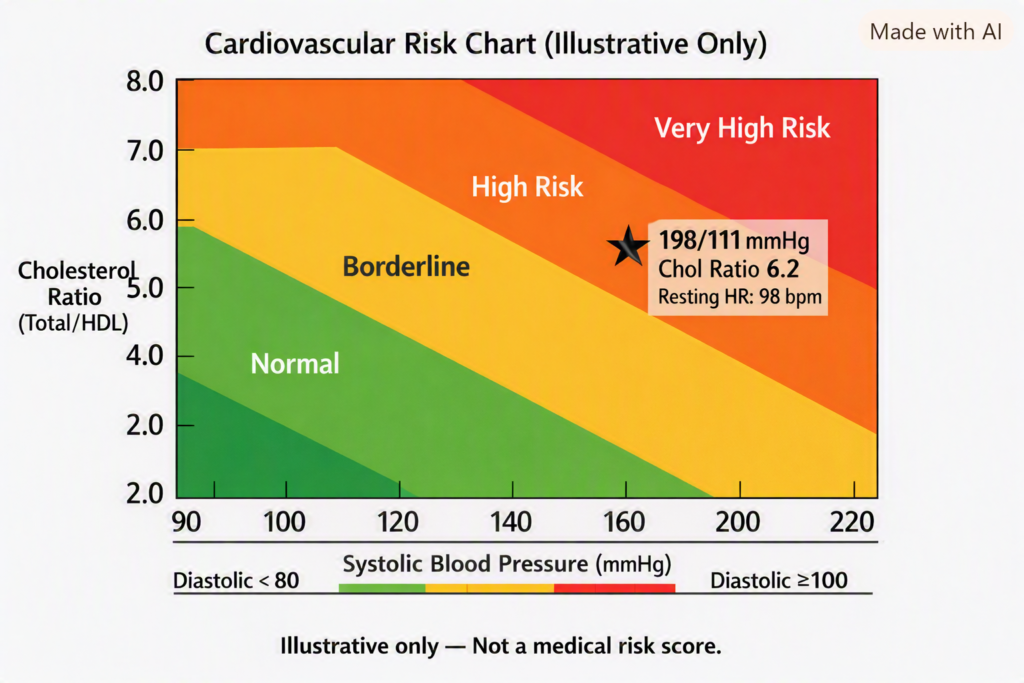
We were close friends, he wasn’t joking, he was worried.
His point sunk in. I realised I couldn’t keep living the way I had been, drinking, eating whatever was convenient, and doing very little exercise. So, I started making changes. The beginning of taking my health seriously for the first time.
A month later, I found myself back at the private medical centre for another session on the metabolic cart. This time given my lifestyle and dietary changes, I was at least able to finish the test. Although they remained unimpressed. I was determined to crack this.
Dealing with High Blood Pressure
When you’re first told you have high blood pressure, it’s easy to assume it’s caused by the usual suspects of stress, work pressure, getting older, eating the wrong things, not exercising enough. This is the advice your given and it makes sense. You are given something simple to blame and a way to fix it that will undoubtedly help. So, you focus on lifestyle changes, diet tweaks, gym memberships, and cutting back on salt, believing that’s all there is to it.
It appears the problem is that hypertension is often far more complicated than it looks. It’s a symptom with dozens of possible causes, and unless someone digs deeper, you can end up treating the number without ever understanding the reason behind it. That’s exactly why I am apparently not alone in spending years trying to “manage” my blood pressure instead of actually solving it.
Looking back, it’s no surprise I misinterpreted mine. When a condition hides itself so well, you naturally assume the simplest explanation, not knowing that something else is quietly working in the background.
I didn’t know it then, but this was only the beginning of a very long journey. I thought lifestyle changes would fix everything, but they didn’t. No matter how hard I tried, my blood pressure refused to behave.
And I had no idea why. I assumed this was down to the cards I had been dealt at birth or the many years of poor lifestyle or both.
The next episode relays the changes I made to my life and their impact